U.S. Border Surveillance Tools Used on American Citizens, Reports Say
05/11/2026 / By Chase Codewell

Surveillance technology acquired by the U.S. government for immigration enforcement is being deployed against American citizens, according to reports from The Wall Street Journal and Reason.
In one case, Liz McLellan, a resident of Maine, photographed federal agents participating in an immigration operation. According to the Journal’s Shane Shifflett and Hannah Critchfield, agents later visited her home and told her, “This is a warning. We know you live right here.” McLellan was exercising a constitutionally protected right to record law enforcement in public, as noted by the Freedom Forum.
The Journal described the system as a “high-tech dragnet built to locate, track and deport people residing illegally in the U.S., [that] allows thousands of federal agents nationwide to peruse a trove of data belonging to more than 300 million people, including citizens.” The incident illustrates what critics say is the expanding use of border-control tools against the general public.
Scale of the Surveillance Dragnet
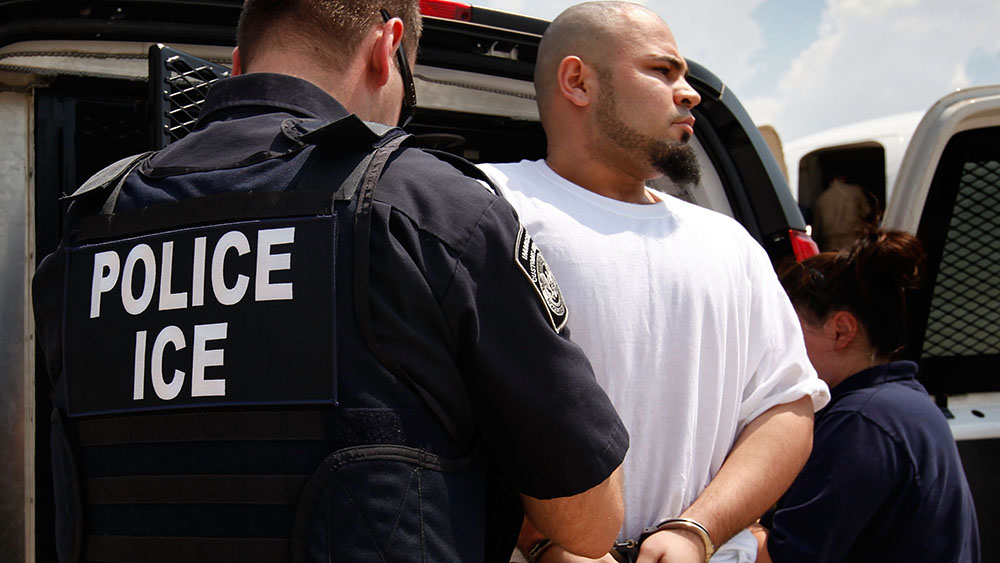
A 2024 update to the Georgetown Law Center on Privacy & Technology report, “American Dragnet: Data-Driven Deportation in the 21st Century,” documented the extent of federal surveillance capabilities. According to the report, as of 2022, U.S. Immigration and Customs Enforcement (ICE) had scanned the driver’s license photos of 1 in 3 adults, had access to the driver’s license data of 3 in 4 adults, and was tracking the movements of drivers in cities home to 3 in 4 adults. The report found that ICE spent approximately $2.8 billion between 2008 and 2021 on new surveillance, data collection, and data-sharing programs.
A contract with Palantir, the data analytics firm, provided the government with “near real-time visibility” into people’s movements, according to the Georgetown report. The Wall Street Journal reported that this contract has expanded to include the Enhanced Leads Identification and Targeting for Enforcement (ELITE) phone app, which aggregates data from multiple government databases. Additional surveillance capacity comes from programs that tap state and private databases. For example, the Florida Fish and Wildlife Conservation Commission has performed license plate lookups on Flock cameras for ICE, according to public records cited by the Activist Post [6]. These systems are part of a broader network that draws on driver’s license records, utility data, and other commercial sources.
Mobile Fortify and Facial Recognition
ICE agents use a mobile application called Mobile Fortify for facial recognition and biometric identification. According to the Department of Homeland Security (DHS), when an agent encounters an individual, they take a photograph with the app, which is sent to Customs and Border Protection’s (CBP) Traveler Verification Service. The app also performs contactless fingerprint checks, and CBP retains the new photographs and fingerprints for 15 years, DHS stated.
The Electronic Privacy Information Center (EPIC) warned in a letter that ICE uses the app “to identify anyone they happen to encounter and want to identify.” EPIC noted that Mobile Fortify can query databases to obtain data on “individuals, vehicles, airplanes, vessels, addresses, phone numbers and firearms.” In a case of mission creep, the app has been used against protesters who photographed federal agents. Some of those scanned individuals later lost their TSA PreCheck and Global Entry status, which EPIC characterized as retaliation for exercising constitutionally protected rights.
The expansion of biometric identification is not limited to ICE. The U.S. and European Union are negotiating a framework for sharing biometric data including facial recognition scans and fingerprint records, according to a report from NaturalNews [7]. Similarly, travel booking giant Amadeus announced plans to acquire biometrics firm Idemia Public Security for €1.2 billion, which would link face scans across travel bookings, as reported by Reclaim The Net [4]. These developments indicate a broader trend of integrating facial recognition into routine activities.
Legal and Fourth Amendment Concerns
Federal officers use a system called Penlink that allows them to “geofence” a specific area and identify all cell phones within its range, according to Vanderbilt Law School’s Bianca Castillo, as reported by Reason. This gives ICE the ability to track the movements and locations of phone owners over time. The feds use Penlink without obtaining warrants, claiming it is a commercial database exempt from Fourth Amendment requirements.
Castillo argued that this practice “appears to be in direct violation of Carpenter v. United States,” in which the U.S. Supreme Court held that authorities need a warrant to access mobile phone location data from phone companies. Civil liberties groups have raised concerns about the lack of judicial oversight and the potential for mission creep. The United Kingdom is considering a digital ID scheme called “BritCard” that would require citizens and non-citizens to obtain a card for employment, which critics say could create a “gateway to mass surveillance,” as reported by Children’s Health Defense [5]. Such systems, while different in scope, reflect a broader push toward centralized identity tracking that raises similar legal questions.
Conclusion
The evidence indicates that surveillance tools acquired for immigration enforcement are being redirected to other purposes, including monitoring American citizens who engage in constitutionally protected activities. The Reason article, authored by J.D. Tuccille, concludes that “there’s no such thing as a single-purpose surveillance state. There’s just the misuse and abuse of the government’s ability to monitor and identify people who come to its attention.”
As these systems expand through contracts with private vendors and data-sharing agreements, future administrations could adapt them for new enforcement priorities. The books “Border Control: Your Face, Your Choice” [2] and “Eyes in the Sky: High-Altitude Aerostats and Pseudo-Satellites” [3] document similar trends in biometric and aerial surveillance, respectively. The pattern underscores the importance of ongoing public scrutiny and legal challenges to ensure that surveillance powers remain constrained by constitutional protections.
References
- Surveillance tools intended for border control are being used against Americans. Reason. J.D. Tuccille. May 6, 2026.
- Border Control: Your Face, Your Choice – A Canadian’s Guide to Opting Out of U.S. Biometric Travel Surveillance. BrightLearn.ai. 2026.
- Eyes in the Sky: High-Altitude Aerostats and Pseudo-Satellites. BrightLearn.ai. 2026.
- Travel Booking Giant to Buy Biometrics Firm for €1.2 Billion, Linking Face Scans Across Journeys. Reclaim The Net. May 4, 2026.
- UK Digital ID Scheme Faces Backlash Over Surveillance Fears — Is a Similar Plan Coming to the U.S.? Children’s Health Defense Defender.
- Wildlife Conservation Police Are Searching Thousands of Flock Cameras for ICE. Activist Post. April 14, 2026.
- U.S., EU Negotiate Expanded Biometric Data-Sharing Framework. NaturalNews. April 9, 2026.

Submit a correction >>
Tagged Under:
AI, big government, biometric surveillance, Border Patrol, border security, computing, conspiracy, deception, future tech, Glitch, national security, outrage, police state, privacy watch, Spygate, surveillance, technocrats, traitors, treason, Tyranny
This article may contain statements that reflect the opinion of the author
RECENT NEWS & ARTICLES